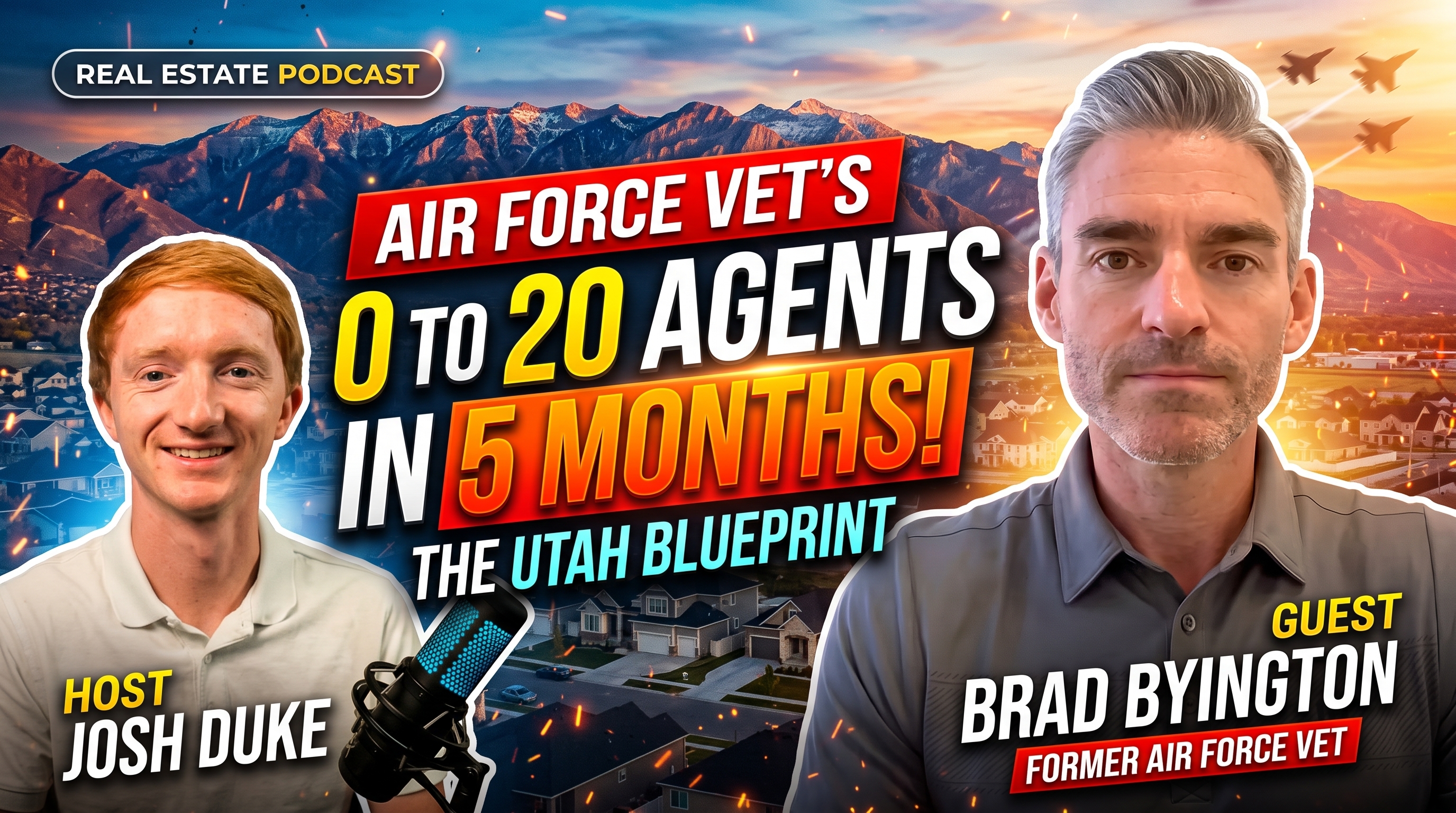
Realtor 500: Josh Duke Talks Building a Brokerage and Abundance Mindset With Brad Byington of Skyline Real Estate Group
The Air Force Veteran Who Got His License to Buy Investment Properties and Never Looked Back
Josh Duke welcomed Brad Byington, broker and owner of Skyline Real Estate Group in Draper Utah, to the Realtor 500 podcast for a conversation about what it actually takes to build a brokerage from scratch, why the abundance mindset is the single most important competitive advantage in real estate, and what separates the agents who last from the ones who flame out after a year.
Brad spent sixteen years in the Air Force and during the final stretch of his service he started thinking seriously about real estate investing. He had been coaching the Dave Ramsey Financial Peace University program at multiple military installations, helping service members get their finances in order, and the next step in those conversations was always real estate. When he moved to Utah with the Air Force he hired a real estate agent, had a good experience, and thought he could do that. He got his license, started transacting for himself, helped friends and family, and the referrals started coming before he ever had a formal business plan. Within a short time the real estate income eclipsed what he was earning in the Air Force and he transitioned out of the military and into full-time real estate.
Seven years later he has opened his own brokerage, brought twenty agents in the first five months, and is doing more commercial and land transactions than residential while simultaneously leading the team and running his own production.
Why Years in the Business Is the Wrong Metric
Brad opens with a perspective that Josh echoes from the lending side. Seven years in real estate feels short when you are on the phone with someone who has been in the business for forty years and assumes that tenure equals expertise. Brad has met agents with one year of experience who run laps around people who have been licensed for decades.
The number is irrelevant. What matters is what you do for your clients, how seriously you take the profession, and what life experience you bring to the table. Brad's sixteen years in the Air Force, his coaching background in personal finance, and his transition into commercial and land work have built a knowledge base that no licensing anniversary creates on its own.
How Twenty Agents in Five Months Actually Happened
The first wave was organic. When Brad left the previous brokerage and opened Skyline Real Estate Group the majority of the branch he had been leading moved with him. That foundation was built on trust developed over years of working together and a culture that agents genuinely wanted to stay inside.
The second wave came from word of mouth. When agents in the market heard that Brad had opened his own shop several reached out and joined without a formal recruiting process. They wanted to be around people who were doing good things because proximity to success is one of the most reliable accelerators in any profession.
The third wave has come from more intentional outreach. Ads, posting online, and a practice Brad considers one of the best recruiting strategies available. When he finishes a transaction on the opposite side from an agent who did exceptional work he gets on the phone with that agent afterward and asks them about working together in a more permanent way. Talent recognizes talent and that conversation has produced results consistently.
The Culture That Attracts and Retains Agents
Brad's guiding philosophy is explicit about what he will not do. He will not be the broker who has twenty agents and does not know their names. That is a real conversation he had with a successful broker two years ago that crystallized exactly the kind of brokerage he would never build.
Skyline Real Estate Group is a place for people to collaborate. The agents are independent contractors running their own businesses under the same umbrella which is standard in the industry. The difference is they feel respected and valued as individuals rather than as revenue units attached to a split structure.
Brad acknowledges that running the brokerage is not primarily a moneymaking venture. It needs to not lose money but the purpose is the environment it creates. When agents feel genuinely supported and surrounded by people who are better than them they grow. When they feel like a number on a roster they leave, and the revolving door produces worse service for every client who gets an agent who is constantly starting over.
The Abundance Mindset in Practice
There are nineteen thousand real estate agents in Utah. There are two thousand five hundred real estate brokerages. The average person knows at least ten agents whether they realize it or not. In that environment the scarcity mindset that drives territorial behavior is both misguided and self-defeating.
Brad describes an agent who is essentially protective of a particular neighborhood as if other agents should not work there. That mindset produces friction, closed collaboration, and ultimately fewer deals. The abundance mindset produces the opposite. There is a deal for every agent and an agent for every client. When you work collaboratively and openly the deals find their way to the right people.
The practical application of abundance thinking is about how you introduce yourself professionally. Most real estate agents when asked what they do say something like I do real estate and move on quickly as if they are slightly embarrassed by it. Brad's reframe is direct. I help people buy and sell real estate. Have you had a good experience with a real estate agent recently? That opening creates a conversation and conversations create opportunities. Staying front of mind requires consistency across multiple channels every month. Physical mail. Social media. Email with a value-add element like a home value update or a contractor list. Texts. None of it works in isolation but together it ensures that when someone makes the decision to buy or sell you are the first person they call.
What Makes a Sustainable Real Estate Business
Brad's observations about what separates lasting agents from those who leave within a year are grounded in patterns he has watched play out repeatedly. The agents who flame out are typically the ones who got in believing that opening a door produces a paycheck with minimal effort. That is not how it works. It is more hours than most people expect. The income is delayed. The pipeline requires constant attention even when an active transaction is consuming most of your focus.
The pipeline is the business. Focusing entirely on the current deal at the expense of generating the next one produces the roller coaster that burns agents out. Every day something has to go into the pipeline whether it is a call, a text, a piece of mail, or a conversation. The agents who understand this and work it consistently create a business that compounds. The ones who treat lead generation as something they will get back to after closing find themselves starting over every time.
Brad also emphasizes that action solves all problems. He has seen agents working forty hours a week with one deal while knowing agents who work eight hours and close five deals a month. The difference is not effort level. It is the right action applied consistently. The phone calls never come to you. You make them. The deals do not call you. You go find them. That is the go-getter mentality and it is either present in someone or it is not. You can teach forms and process and scripts. You cannot train the fundamental willingness to pick up the phone.
His Advice for New Agents and Agents Looking to Level Up
Find a team composed primarily of agents who are better than you. That is the most concentrated advice Brad offers and he means it without qualification. There are two thousand five hundred brokerages in Utah. There is one that fits you if you look for it. Interview ten. Talk to the ones that are actually doing things worth being part of. And notice something important about the brokerages that are genuinely crushing it. They are usually not the ones making the recruiting calls. They are attracting people because of what they are building and you have to seek them out.
You grow where you are planted. If the soil is right the growth happens naturally. If you are surrounded by agents who are better than you the standard rises and you rise with it. If you are surrounded by agents who are comfortable with mediocre results that is what you will produce.
What Skyline Real Estate Group Is Building
The first office is in Draper. A second office is being scoped in southern Davis County or northern Salt Lake County to serve agents and clients north of the current location. Offices in southern Utah and Park City are also under consideration as Brad expands the multi-MLS coverage that allows Skyline agents to transact across Washington County, Park City, and the greater Salt Lake area.
The brokerage is actively recruiting agents who have the go-getter mentality, are coachable, are willing to work the consistent daily activities that build a pipeline, and want to be surrounded by people who are operating at a high level.
How to Reach Brad Byington
Visit sreutah.com. Brad's contact information is on the site and he is also easily findable on social media. He is direct, responsive, and genuinely interested in conversations with agents who are ready to find the right environment to grow.
Sources
UtahAssociationofRealtors.com
NAR.realtor
MortgageNewsDaily.com
ConsumerFinancialProtectionBureau.gov
Investopedia.com
